When a crew member aboard the Maersk drilling platform experienced sudden cardiac arrest 120 nautical miles from shore, the survival outcome depended entirely on his colleagues’ immediate response. The nearest medical evacuation helicopter was 45 minutes away an eternity when brain damage begins within 4-6 minutes of cardiac arrest. Three crew members with current BLS certification initiated CPR within 90 seconds, used the onboard AED, and maintained life support until the medevac arrived. The worker survived with full neurological recovery.
This scenario repeats across offshore industries: oil and gas platforms, commercial fishing vessels, cargo ships, remote mining operations, and construction sites in isolated locations. When medical emergencies occur hundreds of miles from hospitals, trained first responders among the crew represent the difference between tragedy and survival. Yet maintaining current BLS certification for these dispersed, continuously rotating offshore teams poses enormous logistical challenges that BLS certification online platforms are helping to solve.
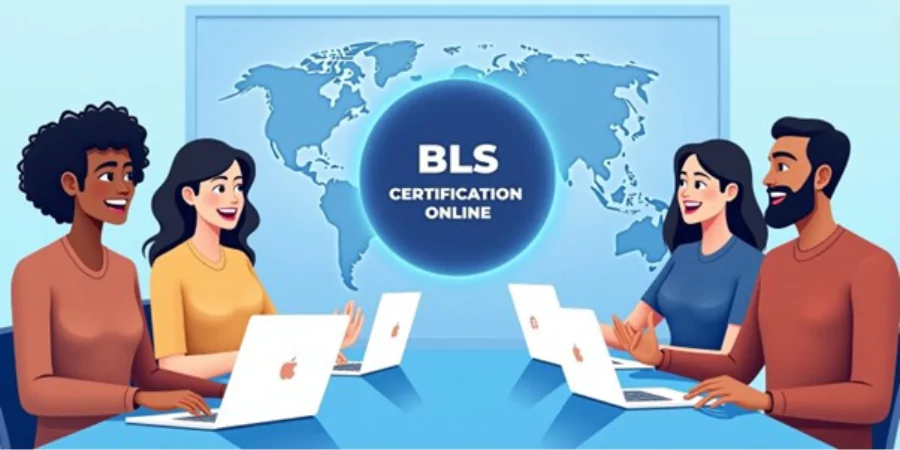
The critical distinction: legitimate online BLS programs don’t replace hands-on skills training they make it more accessible through hybrid models that combine flexible online theory with efficient in-person skills validation. Understanding this distinction is essential for offshore organizations implementing compliant, effective life-saving training programs.
The Offshore Safety Challenge
Offshore and remote industrial teams face unique medical emergency risks that make BLS training essential rather than optional. The statistics are sobering: according to the Bureau of Safety and Environmental Enforcement, the offshore oil and gas industry experiences approximately 2,000 recordable injuries annually in U.S. waters alone, with cardiac events representing a leading cause of offshore fatalities among aging workforces.
The isolation creates multiple compounding challenges. Medical evacuation from offshore platforms averages 2-6 hours depending on weather, location, and helicopter availability. Remote mining sites in regions like Western Australia or Northern Canada may be 4-8 hours from trauma centers. Commercial fishing vessels operate days from port. During these critical windows, properly trained crew members provide the only medical intervention available.
Traditional offshore safety training faced substantial obstacles. Crew rotations mean workers cycle on and off platforms on varying schedules, making coordinated classroom training difficult. Flying workers to shore-based training facilities for 4-8 hour BLS courses costs thousands per person in lost work time, travel expenses, and accommodation. Certification expires every two years, requiring the entire process to repeat continuously. For companies managing hundreds or thousands of offshore workers, these logistics created persistent training gaps and compliance challenges.
Understanding Online BLS: What Works Offshore and What Doesn’t
Critical clarification: no fully online BLS course satisfies American Heart Association (AHA), Red Cross, or other legitimate certifying body standards. These organizations explicitly require hands-on skills demonstration for certification. Anyone claiming to offer “100% online BLS certification” is either selling non-accredited training or misleading customers about requirements.
What does work: hybrid online BLS programs that divide training into two components comprehensive online theory modules followed by abbreviated in-person skills assessment sessions. This model, formally approved by the AHA in their “HeartCode BLS” program and similar Red Cross offerings, maintains rigorous standards while dramatically improving accessibility.
The Hybrid Model Explained
Students complete 2-4 hours of online coursework covering BLS theory: recognition of cardiac arrest and respiratory emergencies, activation of emergency response systems, high-quality CPR techniques, proper AED use, relief of choking, and two-rescuer CPR coordination. The online modules use interactive scenarios, video demonstrations, knowledge checks, and assessments that must be passed before advancing.
This online portion can be completed flexibly during offshore downtime, between shifts, or before deployment. Once the theory component is finished, students attend a shortened in-person skills session (typically 1-2 hours versus 4-5 hours for traditional full courses) where certified instructors verify hands-on competency in:
- Performing high-quality chest compressions on manikins (proper depth, rate, recoil)
- Delivering effective rescue breaths with proper technique
- Operating AED devices correctly
- Managing choking victims using abdominal thrusts
- Coordinating two-rescuer CPR with appropriate role switching
Only after demonstrating these practical skills does the instructor issue certification cards. This hybrid approach maintains the integrity of BLS certification while reducing the time commitment for in-person sessions by 50-70%.
Strategic Benefits for Offshore Operations
The hybrid online model addresses specific pain points in offshore safety management that traditional training couldn’t solve effectively.
Scheduling Flexibility for Rotating Crews
Offshore operations typically use rotation schedules: 14 days on/14 days off, 28/28, or other variations. Coordinating classroom training for workers on different rotation cycles proved nearly impossible. Workers might need recertification while offshore, creating compliance gaps, or might spend their shore leave attending mandatory training.
Hybrid programs allow theory completion during any schedule gap offshore downtime, shore leave, or between rotations. Skills sessions can be scheduled in concentrated blocks: companies can arrange for instructors to visit offshore facilities during crew changeovers, or workers can complete skills assessments at coastal training centers during port calls or between rotations.
Chevron’s Gulf of Mexico operations implemented hybrid BLS training in 2023, reducing training-related work interruptions by 73% while achieving 98.7% compliance rates up from 87% under their previous traditional training model. Workers completed theory modules during offshore downtime, then validated skills during planned shore visits, eliminating the need for dedicated training trips.
Cost Efficiency at Scale
For organizations with large offshore workforces, hybrid training generates substantial cost savings. Traditional BLS courses required:
- Travel costs: flights or transportation to training facilities ($200-800 per person)
- Accommodation for workers traveling from remote locations ($100-300 per night)
- Lost productivity: full day away from work (8-12 hours at $50-150/hour loaded labor cost)
- Instructor fees for full-length courses ($800-2,000 per session for groups)
Hybrid models eliminate most travel and accommodation costs while reducing lost productivity by 60-75%. The condensed in-person sessions mean instructors can validate more workers per day, reducing per-person training costs.
A Norwegian offshore wind company calculated that switching to hybrid BLS training saved approximately $1,200 per worker per certification cycle across their 400-person offshore workforce $480,000 in annual training costs while improving compliance and reducing certification lapses.
Standardized Quality Across Distributed Teams
Offshore teams work across multiple platforms, vessels, and sites, often managed by different contractors or divisions. Traditional training meant workers received BLS instruction from various providers with inconsistent quality, emphasis, and teaching approaches.
Online theory modules from accredited providers ensure every worker receives identical foundational instruction regardless of location or employer. The comprehensive digital content, developed by subject matter experts and regularly updated to reflect current guidelines, provides higher quality baseline education than many in-person instructors could deliver in variable classroom settings.
This standardization proves particularly valuable for multinational operations where offshore teams span multiple countries. A worker trained offshore Brazil, then transferred to a North Sea operation, has received identical BLS theory foundation as their new colleagues, despite training through different in-person skills instructors.
Documentation and Compliance Tracking
Regulatory compliance in offshore industries demands meticulous training documentation. OSHA, Bureau of Safety and Environmental Enforcement, Coast Guard, and international maritime authorities require proof of current safety certifications.
Digital platforms create automatic compliance tracking that paper-based systems couldn’t match. Administrators access dashboards showing which workers hold current certifications, who requires recertification in the next 90 days, and which employees have incomplete training. Automated reminders notify workers when recertification approaches, reducing administrative burden while preventing certification lapses.
Integration with workforce management systems allows real-time verification that only currently certified personnel are deployed to offshore locations a critical capability when regulators can audit compliance at any time and levy substantial fines for violations.
Implementation Strategies for Offshore Organizations
Successfully deploying hybrid BLS training requires strategic planning beyond simply purchasing online access. Organizations achieving the best outcomes follow structured implementation approaches.
Selecting Accredited Programs
First priority: verify that any online BLS program is sanctioned by a legitimate certifying body. The American Heart Association’s HeartCode BLS and Red Cross online programs represent the gold standards in the United States. These programs meet both regulatory requirements and insurance carrier standards for offshore operations.
International operations should verify local recognition. European offshore operations might use European Resuscitation Council accredited programs. Asia-Pacific operations should confirm acceptance by local maritime authorities and workplace safety regulators.
Verification matters because non-accredited “BLS certificates” provide no legal protection. If an offshore medical emergency results in adverse outcomes and investigators discover workers held certificates from non-recognized providers, companies face significant liability exposure beyond the tragedy itself.
Infrastructure and Technology Access
Offshore internet connectivity, while improving, remains variable. Some platforms have reliable broadband; others operate with limited satellite bandwidth. Online training platforms must function across this spectrum.
Look for programs offering:
- Downloadable content: Workers can download theory modules while onshore or during high-bandwidth windows, then complete training offline
- Mobile compatibility: Tablets and smartphones allow training in various offshore locations rather than requiring computer access
- Progress saving: Automatic save features prevent lost progress if connectivity drops
- Minimal bandwidth requirements: Video compression and adaptive streaming that function on limited connections
Test platforms on your actual offshore infrastructure before committing. A program that works perfectly on office WiFi may prove unusable on platform satellite connections.
Scheduling In-Person Skills Sessions
The shortened skills validation sessions still require careful coordination. Several approaches work for offshore operations:
Mobile instructor deployment: Certified instructors travel to offshore platforms during crew changeovers or planned shutdowns, validating multiple workers in concentrated sessions. This works well for large platforms with enough workers to justify instructor mobilization costs.
Shore-based validation centers: Establish relationships with coastal BLS training centers near your primary ports or crew change locations. Workers complete skills sessions during shore leave or between rotations. This approach works better for operations with smaller distributed crews.
Regional validation events: For companies with workers dispersed across large geographic areas, organize quarterly or semi-annual validation events in central locations where workers traveling for other reasons (safety meetings, maintenance training) can consolidate skills sessions.
Contractor coordination: For operations using multiple contractors, coordinate shared validation sessions rather than each contractor arranging separate training. This reduces costs while ensuring consistent standards across the entire offshore workforce.
BP’s North Sea operations use a hybrid approach: mobile instructors visit major platforms semi-annually while maintaining relationships with Aberdeen training centers for workers between rotations or with urgent recertification needs. This combination achieved 99.2% current certification rates across their 3,000+ offshore workforce.
Integration with Broader Safety Culture
BLS training shouldn’t exist in isolation from other safety initiatives. The most effective implementations integrate BLS with comprehensive offshore medical emergency preparedness.
This includes:
- Regular emergency drills that incorporate BLS skills beyond just practicing techniques simulating realistic offshore medical scenarios
- Medical equipment maintenance ensuring AEDs, oxygen delivery systems, and medical supplies are accessible and functional
- Clear emergency protocols defining roles and responsibilities when medical emergencies occur
- Communication procedures establishing how offshore teams contact emergency medical services and coordinate evacuations
- Psychological preparation helping workers understand the stress of real emergencies differs from practice scenarios
Shell’s offshore operations combine mandatory BLS recertification with quarterly medical emergency drills that use high-fidelity manikins simulating realistic casualties. Post-drill debriefs identify improvement areas, creating continuous learning beyond the certification requirements themselves.
Addressing Hands-On Skills Proficiency
The persistent challenge with hybrid BLS training: ensuring hands-on proficiency matches traditional full-course outcomes despite reduced in-person time. This requires attention beyond simply meeting minimum certification requirements.
Skills Retention and Practice Opportunities
Research consistently shows that BLS skills decay rapidly without practice. Studies in Resuscitation journal demonstrate that CPR quality deteriorates significantly within 3-6 months post-training without refresher practice.
Leading offshore organizations supplement certification requirements with ongoing practice opportunities:
Quarterly refresher sessions: Brief 15-30 minute practice opportunities using platform medical equipment, reinforcing techniques without requiring formal recertification
Buddy system practice: Pairing workers to practice skills together during downtime, similar to how firefighters regularly drill techniques
Scenario-based exercises: Monthly or quarterly medical emergency drills that require applying BLS skills in realistic contexts
Just-in-time refreshers: Digital quick-reference videos accessible on mobile devices, allowing workers to review techniques immediately before drills or if emergencies occur
These supplemental practices cost little but significantly improve skill retention and confidence. Workers who practice quarterly demonstrate measurably better CPR quality than those who only train during biennial recertification.
Measuring Training Effectiveness
Progressive organizations don’t just track certification compliance they measure whether training translates to actual emergency readiness. Metrics include:
Drill performance data: During simulated emergencies, are BLS interventions initiated promptly? Is CPR quality adequate? Are AEDs deployed correctly?
Real emergency outcomes: When actual medical emergencies occur, how did BLS-trained responders perform? What worked well? What gaps appeared?
Self-reported confidence: Surveys asking workers how confident they feel about responding to medical emergencies, identifying psychological barriers beyond technical skills
Equipment readiness audits: Regular verification that AEDs function, medical supplies are accessible, and emergency equipment is maintained training is useless if equipment fails
Time-to-intervention metrics: In drills, how quickly do trained responders initiate BLS? Faster response directly correlates with improved outcomes
This data-driven approach identifies whether hybrid training delivers equivalent outcomes to traditional methods, or whether additional interventions are needed.
Regulatory Compliance and Legal Considerations
Offshore operations face complex regulatory oversight from multiple agencies with varying BLS training requirements. Understanding these requirements prevents compliance gaps that create both legal liability and genuine safety risks.
Industry-Specific Requirements
Different offshore sectors face different regulatory frameworks:
Oil and Gas: BSEE (Bureau of Safety and Environmental Enforcement) requires specific safety training for U.S. offshore operations, with some facilities mandating certain numbers of BLS-certified workers based on crew size. International operations face requirements from host country authorities plus international standards like ISO 45001.
Maritime: Coast Guard and International Maritime Organization regulations mandate medical training for certain crew positions on vessels. BLS certification often satisfies these requirements, but verification of specific acceptability is essential.
Mining: MSHA (Mine Safety and Health Administration) requires mine emergency response training, which may incorporate or supplement BLS certification depending on mine characteristics and location.
Construction: Offshore construction projects (wind farms, platforms, pipelines) must comply with OSHA requirements plus potentially host country regulations, contractor requirements, and insurance carrier mandates.
Verify specific requirements for your industry and jurisdiction before implementing any training program. Regulatory agencies can provide guidance on whether specific online/hybrid BLS programs satisfy their requirements.
Insurance and Liability Protection
Insurance carriers providing coverage for offshore operations increasingly specify safety training requirements including BLS certification. Some carriers offer premium reductions for operations with high BLS certification rates, recognizing that trained workforces present lower risk.
From a liability perspective, maintaining rigorously documented BLS training programs provides critical protection. If offshore medical emergencies result in adverse outcomes, investigations will scrutinize whether the employer provided adequate safety training. Documented, accredited BLS certification from recognized providers demonstrates due diligence far more effectively than informal or non-accredited training.
Conversely, non-compliant training creates liability exposure. If workers hold “BLS certificates” from non-accredited online providers that don’t include hands-on skills validation, legal analysis might conclude the training was inadequate exposing the employer to negligence claims.
Real-World Implementation: Case Studies
Examining how offshore organizations successfully implemented hybrid BLS training illustrates practical approaches and outcomes.
Case Study: North Atlantic Fishing Fleet
A commercial fishing company operating 40 vessels faced persistent BLS training challenges. Vessels spent 10-30 days at sea on fishing trips, making shore-based training difficult. Traditional approaches meant crew members often worked with expired certifications, creating compliance problems and genuine risk.
Implementation approach:
- Partnered with Red Cross online BLS program for theory training
- Crew completed online modules during port time or between trips using tablets provided by the company
- Established relationships with BLS instructors in all primary ports where vessels dock
- Scheduled skills sessions during routine port calls when vessels were loading supplies or undergoing maintenance
- Created floating deadline system: certification must be current before vessel departure, but workers have flexibility in when they complete theory and schedule skills sessions within their certification window
Results after 18 months:
- Certification compliance increased from 73% to 97%
- Training costs per worker decreased by $620 (primarily eliminating travel and lost work time)
- Two actual medical emergencies during the study period (one cardiac event, one severe injury) with BLS-trained crew providing life-saving intervention both times
- Worker satisfaction surveys showed 89% preferred hybrid model to previous traditional training
Case Study: Multinational Energy Corporation
A major energy company with offshore operations across five continents struggled to standardize BLS training quality across regions with different training providers, languages, and regulatory frameworks.
Implementation approach:
- Standardized on AHA HeartCode BLS for all global operations
- Translated online content into six languages for their diverse workforce
- Established regional validation centers near major crew change hubs (Houston, Aberdeen, Singapore, Perth, Rio de Janeiro)
- Created traveling instructor program for remote platforms where shore-based validation was impractical
- Integrated certification tracking with HR systems to prevent deploying uncertified workers offshore
Results after three years:
- Consistent training quality across all regions despite local instructor variability
- Compliance rates above 98% globally
- $2.3 million annual cost reduction compared to previous regional training arrangements
- Simplified regulatory audits by providing standardized documentation across jurisdictions
- Reduction in medical emergency response time averages (faster initiation of BLS interventions in actual emergencies)
These cases demonstrate that successful implementation requires more than just purchasing online access it demands systematic planning around logistics, technology infrastructure, instructor coordination, and integration with existing safety programs.
The Future of Offshore Emergency Medical Training
BLS represents foundational emergency response training, but offshore medical preparedness continues evolving with technology and improved understanding of remote medicine challenges.
Enhanced Simulation and VR Training
Virtual reality BLS training platforms now allow highly realistic practice beyond basic online theory. Workers using VR headsets practice CPR on virtual patients with realistic feedback about compression depth, rate, and hand positioning. These systems provide individualized skills practice between formal certifications, potentially improving skill retention.
Several offshore operators are piloting VR supplemental training, though it doesn’t replace required hands-on manikin practice for certification. The technology shows promise for more frequent, individualized practice that maintains proficiency between formal recertifications.
Related: Virtual reality revolutionizes classic online slots into 3D games
Telemedicine Integration
Satellite communications improvements enable real-time telemedicine consultations during offshore medical emergencies. BLS-trained first responders stabilize patients while emergency physicians provide remote guidance via video link, improving intervention quality beyond what BLS training alone would provide.
This technology doesn’t reduce the importance of BLS certification it amplifies its effectiveness. The remote physician can only provide guidance if first responders have performed initial assessment and stabilization using BLS skills.
Advanced Life Support for Offshore Medics
Some offshore operations deploy dedicated medics with training beyond BLS often emergency medical technician (EMT) or paramedic certification. Online/hybrid models are emerging for this advanced training too, though the hands-on requirements are significantly more extensive.
The trend suggests a tiered approach: all offshore workers with BLS certification providing immediate response, supplemented by medics with advanced capabilities for complex medical management during extended medevac waits.
Critical Success Factors
Organizations achieving the best outcomes from hybrid online BLS training share common practices:
Leadership commitment: Safety culture starts at the top. When senior management clearly prioritizes BLS certification and provides necessary resources, compliance and quality follow.
Adequate time allocation: Treating BLS training as something workers do “when they have time” produces poor outcomes. Designating specific training periods and protecting that time demonstrates commitment.
Quality instructor relationships: The in-person skills validation is only as good as the instructors delivering it. Partner with experienced, certified instructors who understand offshore work realities.
Technology that works: Online platforms must function reliably on your actual infrastructure. Test thoroughly before deployment.
Integration with broader safety programs: BLS shouldn’t be an isolated checkbox it should integrate with emergency drills, equipment maintenance, and overall safety culture.
Continuous improvement mindset: Track outcomes, gather feedback, identify gaps, and refine the program continually rather than implementing once and forgetting.
Making the Investment Decision
For offshore operations leaders evaluating whether hybrid online BLS training makes sense for their organizations, several factors guide the decision:
Workforce size and distribution: Hybrid training economics improve with larger, more distributed workforces where traditional training logistics are most challenging.
Current compliance rates: If existing approaches achieve high compliance, change may not be necessary. If certification gaps persist, hybrid models often solve the problem.
Regulatory environment: Verify that hybrid programs meet applicable regulatory requirements before committing.
Technology infrastructure: Ensure offshore connectivity supports online training platforms.
Cost-benefit analysis: Calculate current training costs (including travel, lost productivity, and administrative overhead) versus hybrid program costs to quantify potential savings.
Most organizations find that hybrid online BLS training provides clear advantages for offshore operations specifically because the challenges traditional training poses are most acute in these isolated, distributed environments.
Conclusion
Hybrid online BLS certification represents not a compromise on training quality but a strategic improvement in how offshore organizations deliver essential life-saving training. By separating comprehensive theory education (delivered flexibly online) from focused hands-on skills validation (delivered efficiently in-person), these programs overcome the logistical obstacles that previously created persistent training gaps.
The result: higher compliance rates, reduced costs, standardized quality, and most importantly, better-prepared offshore teams capable of responding effectively when medical emergencies occur far from professional medical care. When that drilling platform worker experienced cardiac arrest 120 miles offshore, his survival depended entirely on colleagues whose current BLS certification equipped them to take immediate, effective action.
For offshore organizations, the question isn’t whether BLS training matters it unquestionably does. The question is how to deliver that critical training effectively across dispersed, rotating workforces operating in challenging environments. Properly implemented hybrid online programs, combining accredited digital theory with rigorous hands-on validation, provide the answer that traditional classroom-only approaches couldn’t achieve.
Related: Modern Education Strategies Driving Greater Knowledge