
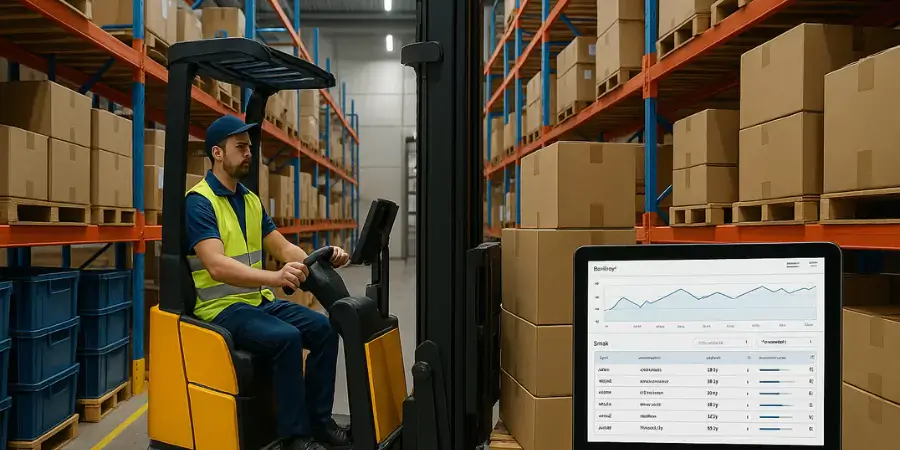
When Zara implemented RFID-based inventory management across its 2,200 stores in 2014, the fast-fashion retailer faced a specific problem: manual inventory counting required 40 hours per store weekly, creating 5-7 day delays between physical counts and system updates. This lag meant stores routinely ran out of popular items while overstocking slow sellers, costing an estimated €250 million annually in lost sales and markdowns. After deploying RFID tags on every garment enabling real-time inventory tracking, Zara reduced inventory counting time to 6 hours weekly per store while achieving 98% inventory accuracy up from 65% under manual systems. The improved accuracy increased same-store sales by 3-5% through better product availability while reducing markdowns by 10% by identifying slow-moving inventory faster. Total implementation cost of €450 million delivered estimated annual benefits of €380 million, achieving payback within 14 months.
This outcome illustrates what research consistently demonstrates: intelligent inventory management systems combining IoT sensors, predictive analytics, and automation deliver measurable returns through reduced carrying costs, improved stock availability, faster fulfillment, and better cash flow management. However, the same research reveals that benefits depend heavily on implementation quality, business context, and realistic expectations about what technology can achieve. Understanding how smart inventory management actually works the specific technologies involved, their costs and capabilities, appropriate use cases, and realistic ROI timelines helps businesses determine whether investment makes sense for their specific circumstances.
The Real Cost of Inventory: Why Management Matters
Before examining smart inventory solutions, understanding total inventory costs provides essential context for evaluating potential improvements. Most businesses drastically underestimate true inventory carrying costs, focusing only on purchase price while ignoring substantial additional expenses.
Total inventory carrying cost components:
Capital costs (8-15% of inventory value annually): Money tied up in inventory can’t be invested elsewhere. A business maintaining $2 million average inventory at 10% cost of capital forgoes $200,000 annually in potential investment returns or debt reduction. This opportunity cost often represents the largest carrying cost component.
Storage costs (2-6% annually): Warehouse rent or depreciation, utilities, property taxes, insurance, and maintenance expenses. A 50,000 square foot warehouse costing $8/sq ft annually runs $400,000 in occupancy costs alone before considering staffing.
Labor costs (3-5% annually): Receiving, put-away, cycle counting, picking, packing, and shipping labor. Wage increases and benefits make labor a growing proportion of carrying costs.
Obsolescence and shrinkage (4-8% annually): Products becoming outdated, damaged, expired, or stolen. Fashion retailers face obsolescence rates of 15-25%, while electronics average 8-12% due to rapid product cycles.
Administrative costs (1-3% annually): Systems, insurance, taxes, and management overhead for inventory control.
Total carrying costs typically range from 20-35% of average inventory value annually. A business maintaining $5 million average inventory faces $1-1.75 million in annual carrying costs far more than most realize when they focus only on purchase price. This creates enormous pressure to minimize inventory levels while maintaining adequate stock to avoid lost sales.
Stockout costs compound the problem: While holding excess inventory costs 20-35% annually, stockouts also damage profitability. Research estimates stockout costs at 20-40% of potential sale value when accounting for lost margin, customer goodwill damage, and switching to competitors. A retailer experiencing 5% stockout rate on $20 million annual sales loses $200,000-400,000 in direct sales plus long-term customer relationship damage.
This creates inventory management’s fundamental tension: holding too much inventory costs 20-35% annually, while holding too little causes stockouts costing 20-40% of lost sales. Smart inventory management aims to optimize this tradeoff through better demand forecasting, dynamic safety stock calculations, and faster replenishment cycles.
RELATED: Top 5 Manufacturing Supply Chain Management Best Practices
Smart Inventory Technologies: What Actually Works
“Smart inventory management” encompasses multiple technologies with different capabilities, costs, and appropriate use cases. Understanding what each technology actually does helps businesses select appropriate solutions rather than investing in unnecessary sophistication.
RFID (Radio Frequency Identification):
How it works: RFID tags attached to products or pallets transmit unique identifiers to readers, automatically tracking item movements without line-of-sight scanning required by barcodes. Passive RFID tags (no battery) cost $0.05-0.30 per tag, while active tags (with battery) enabling longer-range reading cost $5-25 per tag.
Appropriate use cases: High-value products, fast-moving inventory requiring frequent counts, or complex supply chains with many touch points. Fashion retail, pharmaceuticals, aerospace parts, and logistics operations show strongest ROI. Zara’s €0.05 per garment RFID tag cost is justified by labor savings and accuracy improvements, but wouldn’t make sense for low-value commodity products.
ROI data: Companies implementing RFID report 20-30% labor reduction in inventory management, 95-99% inventory accuracy (versus 65-75% with barcodes), and 10-25% sales increases through better stock availability. However, implementation costs range from $100,000-$1 million+ depending on scale, requiring 12-36 months payback periods.
IoT sensors and real-time tracking:
How it works: Internet-connected sensors monitor environmental conditions (temperature, humidity, location) and transmit data to cloud platforms for analysis. Useful for perishable goods, cold chain logistics, or high-value asset tracking.
Costs and benefits: Sensors cost $10-100 per unit with ongoing connectivity fees of $1-5 monthly per device. Appropriate for pharmaceuticals requiring temperature monitoring, food distribution ensuring cold chain integrity, or logistics companies tracking high-value shipments. Less applicable for stable products in controlled warehouse environments.
Warehouse Management Systems (WMS):
How it works: Software managing all warehouse operations including receiving, put-away, picking, packing, and shipping. Modern cloud-based WMS costs $2,000-10,000 monthly for mid-size operations (50,000-500,000 sq ft) versus $100,000-$1 million+ for enterprise on-premise systems.
Core capabilities: Directed put-away optimizing storage locations, wave picking batching orders efficiently, cycle counting scheduling, labor management tracking productivity, and integration with ERP and order management systems.
ROI benchmarks: WMS implementations typically deliver 20-30% picking productivity improvement, 15-25% warehouse space utilization improvement through better slotting, and 99%+ order accuracy. Mid-size implementations cost $200,000-$500,000 including software, hardware, and implementation services, with 18-30 month payback periods.
Predictive analytics and AI:
How it works:Machine learning algorithms analyze historical sales data, seasonality, promotions, weather, economic indicators, and other variables to forecast demand more accurately than traditional methods. Cloud-based analytics platforms cost $500-$5,000 monthly depending on data volume and sophistication.
Forecast accuracy improvements: Advanced analytics typically improve forecast accuracy by 15-35% versus simple moving averages or seasonal models. For a business with $50 million annual sales, a 20% forecast improvement might reduce safety stock by 15-25% (saving $1-2 million in inventory carrying costs) while reducing stockouts by 20-30% (increasing sales by $500,000-$1 million).
Automation and robotics:
How it works: Automated storage and retrieval systems (AS/RS), autonomous mobile robots (AMRs), and robotic picking systems reduce labor requirements while increasing throughput and accuracy. Costs range dramatically from $50,000 for collaborative robots to $10+ million for fully automated warehouses.
Appropriate scale:Automation makes sense for operations with high throughput (10,000+ orders daily), predictable workflow, and multi-year planning horizons. Amazon’s extensive automation investment works at their scale but would bankrupt smaller operations. Most mid-size businesses achieve better ROI through WMS and process improvements before considering robotics.
Inventory Optimization Methods: The Math Behind Smart Management
Beyond technology, smart inventory management requires applying optimization methods that determine how much to order, when to order, and where to position stock. These calculations form the foundation that technology enables but cannot replace.
Economic Order Quantity (EOQ):
EOQ calculates the optimal order quantity minimizing total ordering costs (fixed costs per order like shipping and processing) and holding costs (variable costs based on inventory levels). The formula: EOQ = √(2DS/H) where D = annual demand, S = ordering cost per order, and H = annual holding cost per unit.
Example: A distributor selling 12,000 units annually with $75 ordering cost per order and $4 annual holding cost per unit calculates: EOQ = √(2 × 12,000 × $75 / $4) = √450,000 = 671 units per order. Ordering 671 units approximately 18 times yearly minimizes total costs versus larger orders less frequently (higher holding costs) or smaller orders more frequently (higher ordering costs).
Safety stock calculations:
Safety stock protects against demand variability and supply lead time uncertainty. The basic formula: Safety Stock = Z × √(Lead Time) × Standard Deviation of Demand, where Z represents the desired service level (1.65 for 95% service level, 2.33 for 99%).
Example: A retailer with 50-unit daily average demand, 30-unit standard deviation, and 10-day lead time calculates 95% service level safety stock: 1.65 × √10 × 30 = 156 units. This means maintaining 156 units of safety stock plus average demand during lead time (500 units) = 656 units reorder point.
Smart inventory systems automate these calculations updating them continuously as demand patterns and lead times change rather than using static formulas that become outdated.
ABC analysis and inventory segmentation:
ABC analysis categorizes inventory by importance, typically finding 20% of SKUs generate 80% of revenue (A items), 30% generate 15% (B items), and 50% generate 5% (C items). This enables differentiated management strategies.
Appropriate strategies by category:
- A items: Tight control, frequent counts, sophisticated forecasting, low safety stock (since they move fast), high service level targets (99%+)
- B items: Moderate control, periodic counts, standard forecasting, medium safety stock, 95-97% service levels
- C items: Loose control, annual counts, simple forecasting or min/max rules, potentially higher relative safety stock (since they’re cheap to hold), 90-95% service levels
Many businesses manage all SKUs identically, wasting resources on tight control of low-value items while under-managing critical products.
Real Implementation Examples: What Actually Happened
Beyond vendor marketing claims, examining documented implementations with measurable outcomes provides realistic expectations about benefits, costs, and challenges.
Amazon’s fulfillment center automation:
Amazon has invested over $40 billion in fulfillment automation since 2012 including the $775 million Kiva Systems acquisition (now Amazon Robotics). Results include:
- Operational costs reduced by approximately 20% per unit shipped
- Fulfillment center capacity increased 50% in existing space through denser storage enabled by robots
- Picking productivity increased 2-3x with robots bringing products to stationary pickers
- Inventory accuracy exceeding 99.5% through automated tracking
- Two-day Prime shipping made economically viable through efficiency gains
However, individual fulfillment centers cost $100-250 million to build with automation, requiring massive scale to justify. Amazon processes billions of shipments annually justifying investments that would bankrupt companies processing thousands daily.
Walmart’s supply chain transformation:
Walmart invested $2 billion from 2017-2020 in supply chain modernization including:
- RFID tracking for apparel improving inventory accuracy from 63% to 95%
- Predictive analytics reducing forecast error by 30%
- Automated replenishment cutting grocery out-of-stocks by 16%
- In-stock levels improving from 91% to 98% for high-velocity items
These improvements enabled same-day pickup and delivery services while reducing inventory levels by $1.5 billion (approximately 4% reduction) freeing working capital. The $2 billion investment delivered estimated $800 million annual benefits through reduced stockouts and lower carrying costs, achieving 2.5-year payback.
Mid-size manufacturer implementation:
A $50 million annual revenue manufacturer implemented cloud-based WMS and basic demand forecasting at total cost of $280,000 (software, hardware, consulting, training). Results after 18 months:
- Inventory accuracy increased from 78% to 97%
- Picking productivity improved 22% through directed picking
- Inventory turns increased from 4.2 to 5.8 annually, reducing average inventory from $6.2 million to $4.5 million
- Carrying cost savings of approximately $340,000 annually on reduced inventory
- Order fulfillment time decreased from 3.2 days to 1.7 days average
The implementation achieved 10-month payback primarily through reduced inventory carrying costs and labor productivity gains realistic outcomes for mid-size operations.
When Smart Systems Aren’t Worth the Investment
While smart inventory management delivers measurable benefits, it’s not appropriate for all businesses. Understanding when simpler approaches suffice avoids wasting resources on unnecessary sophistication.
Businesses where basic systems work fine:
Low-volume operations (under 100 orders daily): Spreadsheets and basic barcode scanning handle inventory adequately without sophisticated WMS investments. Implementation costs and learning curves outweigh benefits.
Single-location businesses with simple products: A restaurant or small retailer with 200-300 SKUs can manage inventory through periodic physical counts and simple min/max reordering rules without automated systems.
Highly stable demand patterns: Businesses with predictable seasonal patterns and minimal variability achieve adequate results with simple forecasting and safety stock rules without predictive analytics.
Very low inventory value (under $500,000): When total inventory value is modest, carrying cost savings from optimization rarely justify system investments. Better to focus on sales growth.
Cost-benefit analysis framework:
Before investing in smart inventory systems, calculate:
- Current inventory carrying costs: Average inventory × 25% = annual cost
- Current stockout costs: Annual sales × stockout rate × 30% = lost margin
- Potential improvements: Reduce inventory 15-25%, reduce stockouts 20-40%
- Implementation costs: Software, hardware, consulting, training, disruption
- Annual benefits must exceed 30-40% of implementation costs to justify investment (ensuring 2.5-3 year payback)
A business with $3 million average inventory faces $750,000 annual carrying costs. A 20% reduction saves $150,000 annually. If implementation costs $300,000, the 2-year payback justifies investment. If implementation costs $800,000, the benefits don’t justify the expense.
Implementation Roadmap: How to Actually Do This
For businesses determining that smart inventory investment makes sense, systematic implementation minimizes disruption while maximizing benefit realization.
Phase 1: Assessment and baseline (1-2 months)
Conduct physical inventory establishing accurate baseline. Calculate current inventory turns, carrying costs, and service levels. Document current processes identifying pain points and improvement opportunities. Analyze SKU velocity and categorize inventory (ABC analysis). Establish KPIs for measuring improvement: inventory accuracy, turns, fill rate, fulfillment time.
Phase 2: Technology selection (1-2 months)
Define requirements based on pain points and improvement priorities. Evaluate 3-5 vendors requesting demonstrations and reference customers. Calculate total cost of ownership including software, hardware, implementation, training, and ongoing support. Pilot test finalists if possible before committing. Select solution balancing functionality, cost, implementation timeline, and vendor viability.
Phase 3: Pilot implementation (2-4 months)
Start with single product category, warehouse zone, or location. Train core team thoroughly before rollout. Run parallel with legacy system initially to validate accuracy. Document issues and refine processes before expanding. Measure results against baseline establishing proof of concept.
Phase 4: Full rollout (3-12 months depending on scale)
Expand systematically to additional zones, categories, or locations. Train all users with hands-on practice before going live. Maintain data quality through strict governance and accountability. Integrate with adjacent systems (ERP, order management, transportation).
Phase 5: Optimization (ongoing)
Monitor KPIs weekly identifying areas underperforming targets. Refine forecast models as historical data accumulates. Optimize safety stocks and reorder points based on actual performance. Continuously improve processes based on user feedback and data insights.
Common implementation failures to avoid:
- Skipping proper baseline measurement making results unmeasurable
- Inadequate training causing user resistance and workarounds
- Poor data quality undermining system effectiveness
- Over-customization increasing costs and delaying implementation
- Lack of executive sponsorship when process changes face resistance
- Unrealistic expectations about benefits timeline and magnitude
Conclusion
Smart inventory management delivers measurable value typically 15-25% inventory reductions, 20-35% picking productivity improvements, and 10-20% sales increases through better product availability when implemented appropriately for businesses where benefits justify investment costs. Companies like Zara, Amazon, and Walmart demonstrate that sophisticated inventory systems enable service levels and cost structures impossible with manual approaches, creating sustainable competitive advantages.
However, the same technologies that transform large operations can bankrupt small businesses that invest in unnecessary sophistication. A $50 million manufacturer implementing cloud WMS and basic analytics at $280,000 cost achieved 10-month payback through $340,000 annual savings. A $5 million business with similar $280,000 implementation would face 3-5 year payback that likely doesn’t justify disruption and risk.
The decision framework is straightforward: calculate current carrying costs (inventory × 25%), estimate realistic improvement potential (15-25% inventory reduction, 20-40% stockout reduction), compare to total implementation costs, and invest only when annual benefits exceed 30-40% of implementation costs ensuring reasonable 2.5-3 year payback. For businesses meeting this threshold, systematic implementation starting with pilots and expanding based on proven results minimizes risk while capturing substantial efficiency gains.
Smart inventory management isn’t about adopting every available technology it’s about understanding your specific costs, challenges, and opportunities, then investing strategically in solutions delivering measurable returns for your business context. The smartest inventory management decision is knowing when sophisticated systems make sense and when simpler approaches suffice.
ALSO READ: Revolutionizing Inventory Management with Advanced Warehouse Racking Systems